Home › Guides › AI Crawler Directory & robots.txt Generator
✓ checked 2 October 2026: 36 AI user agents from 14 operators, each verified against the operator’s own documentation · block rates from our crawl of the top 100,000 sites · robots.txt generator · method · download the data
Which AI bots can you block in robots.txt, and do they listen? This directory lists the user agents that AI companies use to collect training data, to build AI search indexes, and to fetch pages when a user asks a chatbot a question. For each one we give the operator, its purpose, the documentation page, what the operator says about robots.txt, and whether it publishes the IP addresses its bot uses. We took every one of those facts from the operator’s own documentation, saved a copy of each page, and checked every claim against the exact wording. We also show how many of the top 100,000 websites already block each agent, using data from our AI-Crawler Census.
Below the directory is a robots.txt generator. Tick the bots you want to keep out and copy the result. It runs entirely in your browser.
Headline numbers
- Sites block AI training far more often than AI search. 8.9% of the top-100k sites with a readable robots.txt (5,167 of 57,847) name OpenAI’s training crawler GPTBot and disallow the whole site. Only 2.6% (1,504) do the same to OAI-SearchBot, which puts sites in ChatGPT search. That’s 3.4 times as many. The pattern repeats at Anthropic: ClaudeBot is blocked 4.2 times as often as Claude-SearchBot. At Apple, the training opt-out Applebot-Extended is disallowed 4.2 times as often as Applebot, the search crawler.
- User-triggered fetchers often don’t promise to follow robots.txt. For 7 of the 9 user-triggered fetchers in the directory, the operator says robots.txt may not apply, or that the fetcher may ignore or bypass it, because a person asked for the page. This applies to OpenAI, Google, Meta, Perplexity, Amazon and Kimi. Anthropic is the exception: it says all three of its bots, including Claude-User, honour robots.txt. Mistral says MistralAI-User “governs which sites these user requests can be made to”. Even so, 2,578 sites (4.5%) block ChatGPT-User.
- Undocumented names are still widely blocked. 3,198 sites block “anthropic-ai” and 2,542 block “Claude-Web”. Neither name appears in Anthropic’s current crawler page, which describes “the three robots that Anthropic uses”. Both are blocked more often than two of those three bots: Claude-SearchBot (1,018) and Claude-User (1,003).
- New agents are barely blocked yet. Kimi-SearchBot is blocked by 51 sites, MistralAI-Index by 112, and Google-Agent, which Google uses for agents that act on a user’s request, by 231.
- Most operators publish their IP ranges. 26 of the 32 crawlers and fetchers in the directory have an official IP list, so you can check that a visitor claiming to be the bot really is. Meta’s crawler page links no list for its three AI agents, and none is linked for MistralAI-Training, AI2Bot or SBIntuitionsBot.
- Two control tokens block training without blocking a crawler. Google-Extended and Applebot-Extended don’t fetch pages. Google and Apple read them only to decide whether content their normal crawlers collect may be used for AI. Blocking them doesn’t remove a site from Google or Apple search. Google-Extended is disallowed by 3,501 sites (6.1%).
- Community lists are useful but mostly unverified. The open-source ai.robots.txt project lists 180 AI-related agent names. For 107 of them (59%), whether the agent respects robots.txt is marked “unclear”, and for 53 the operator is unclear. Where our verified entries overlap with it, it agrees with the operator’s documentation in 27 cases. In 2 cases it says “Yes” where the operator says robots.txt may not apply: ChatGPT-User and Google-Agent.
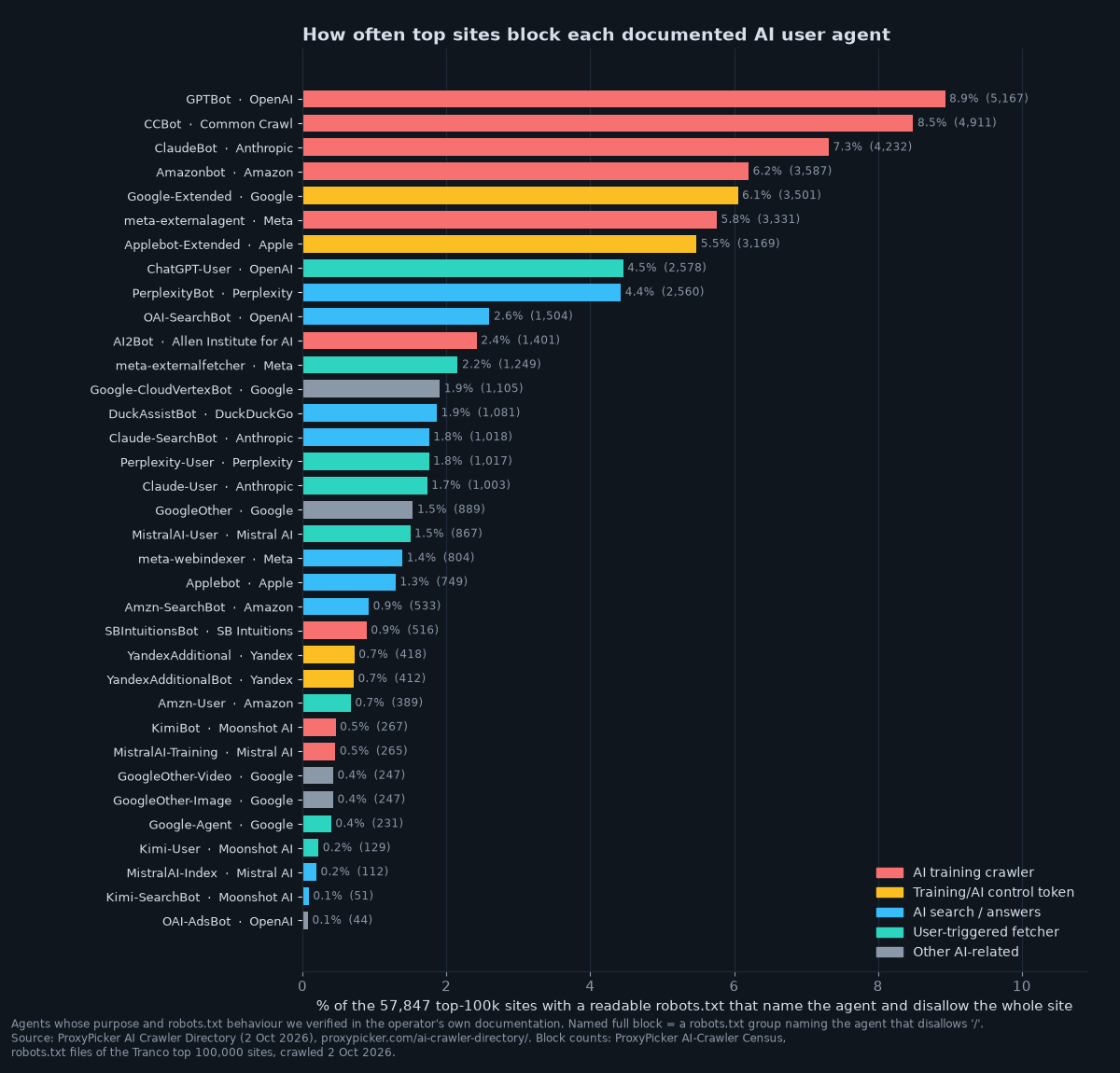
The directory
Every entry below was checked against the linked operator page on 2 October 2026. The robots.txt column summarises what the operator says. “Yes” means the page says the bot follows, respects or honours robots.txt. “Opt-out documented” means the page says how to disallow it but doesn’t make a general compliance statement. “May not follow” means the page says robots.txt may not apply, or the bot may ignore or bypass it. “Blocked by” is the number of the 57,847 top-100k sites with a readable robots.txt that name the agent and disallow the whole site.
AI training crawlers (9)
| User agent (robots.txt token) | Operator | Purpose (per operator) | robots.txt | IP ranges | Blocked by |
|---|---|---|---|---|---|
GPTBot | OpenAI | Crawls content that may be used to train OpenAI's generative AI foundation models. Docs | Opt-out documented | published | 5,167 (8.9%) |
CCBot† | Common Crawl | Builds Common Crawl's open repository of web crawl data that is accessible to anyone. Docs | Opt-out documented | published | 4,911 (8.5%) |
ClaudeBot | Anthropic | Collects web content that could contribute to training Anthropic's models. Docs | Yes | published | 4,232 (7.3%) |
Amazonbot | Amazon | Improves Amazon products and services; may be used to train Amazon AI models. Docs | Yes | published | 3,587 (6.2%) |
meta-externalagent | Meta | Crawls for uses such as training foundation AI models or improving products by indexing content directly. Docs | Opt-out documented | none linked | 3,331 (5.8%) |
AI2Bot | Allen Institute for AI (Ai2) | Finds web content used to train open language models. Docs | Not stated | none linked | 1,401 (2.4%) |
SBIntuitionsBot† | SB Intuitions (SoftBank) | Used for AI development and information analysis. Docs | Yes | none linked | 516 (0.9%) |
KimiBot | Moonshot AI (Kimi) | Crawls content potentially used to train Kimi's foundation models. Docs | Opt-out documented | published | 267 (0.5%) |
MistralAI-Training | Mistral AI | Crawls content to build datasets for training Mistral's generative AI models. Docs | Opt-out documented | none linked | 265 (0.5%) |
Control tokens (no crawler of their own) (4)
| User agent (robots.txt token) | Operator | Purpose (per operator) | robots.txt | IP ranges | Blocked by |
|---|---|---|---|---|---|
Google-Extended | Robots.txt control token: whether content Google crawls may be used to train future Gemini models and for grounding in Gemini Apps and Vertex AI. Not a separate crawler; no effect on Google Search. Docs | Token | n/a (no crawler) | 3,501 (6.1%) | |
Applebot-Extended | Apple | Robots.txt control token: opt out of Applebot-crawled content being used to train Apple's generative foundation models. Does not crawl. Docs | Token | n/a (no crawler) | 3,169 (5.5%) |
YandexAdditional | Yandex | Robots.txt token (also YandexAdditionalBot) to keep a site out of quick answers generated with YandexGPT. Docs | Token | n/a (no crawler) | 418 (0.7%) |
YandexAdditionalBot | Yandex | Alternative token to YandexAdditional (same effect). Docs | Token | n/a (no crawler) | 412 (0.7%) |
AI search and answer crawlers (9)
| User agent (robots.txt token) | Operator | Purpose (per operator) | robots.txt | IP ranges | Blocked by |
|---|---|---|---|---|---|
PerplexityBot | Perplexity | Surfaces and links websites in Perplexity search results; Perplexity says it is not used to crawl content for AI foundation models. Docs | Opt-out documented | published | 2,560 (4.4%) |
OAI-SearchBot | OpenAI | Surfaces websites in ChatGPT search results. Docs | Opt-out documented | published | 1,504 (2.6%) |
DuckAssistBot | DuckDuckGo | Crawls pages in real time for DuckDuckGo's AI-assisted answers; DuckDuckGo says the data is not used to train AI models. Docs | Yes | published | 1,081 (1.9%) |
Claude-SearchBot | Anthropic | Indexes content to improve Claude's search results. Docs | Yes | published | 1,018 (1.8%) |
meta-webindexer | Meta | Improves Meta AI search results, so Meta AI can cite and link to content. Docs | Opt-out documented | none linked | 804 (1.4%) |
Applebot | Apple | Apple's search crawler (Spotlight, Siri, Safari); Apple says the data may also be used to help train its foundation models unless Applebot-Extended is disallowed. Docs | Yes | published | 749 (1.3%) |
Amzn-SearchBot | Amazon | Search experiences in Amazon products such as Alexa; Amazon says it does not crawl for generative AI model training. Docs | Yes | published | 533 (0.9%) |
MistralAI-Index | Mistral AI | Indexes content for Mistral search; Mistral says it is not used for training. Docs | Opt-out documented | published | 112 (0.2%) |
Kimi-SearchBot | Moonshot AI (Kimi) | Builds the index for Kimi's search features. Docs | Opt-out documented | published | 51 (0.1%) |
User-triggered fetchers (9)
| User agent (robots.txt token) | Operator | Purpose (per operator) | robots.txt | IP ranges | Blocked by |
|---|---|---|---|---|---|
ChatGPT-User | OpenAI | Visits pages when a ChatGPT or Custom GPT user asks a question or uses an action. Docs | May not follow | published | 2,578 (4.5%) |
meta-externalfetcher | Meta | Fetches individual links at a user's request, including for agentic AI tasks. Docs | May not follow | none linked | 1,249 (2.2%) |
Perplexity-User | Perplexity | Visits pages when a Perplexity user asks a question. Docs | May not follow | published | 1,017 (1.8%) |
Claude-User | Anthropic | Fetches pages when a Claude user asks a question. Docs | Yes | published | 1,003 (1.7%) |
MistralAI-User | Mistral AI | Visits pages when a Vibe user asks a question. Docs | Opt-out documented | published | 867 (1.5%) |
Amzn-User | Amazon | Fetches live information for user actions such as Alexa queries. Docs | May not follow | published | 389 (0.7%) |
Google-Agent | Agents hosted on Google infrastructure that navigate the web and act on a user's request. Docs | May not follow | published | 231 (0.4%) | |
Kimi-User | Moonshot AI (Kimi) | User-initiated retrieval in Kimi, such as summarising an article. Docs | May not follow | published | 129 (0.2%) |
Google-GeminiNotebook | Fetches URLs that Gemini Notebook users add as sources. Former token Google-NotebookLM is supported until August 2026. Docs | May not follow | published | not measured¹ |
Other AI-related agents (5)
| User agent (robots.txt token) | Operator | Purpose (per operator) | robots.txt | IP ranges | Blocked by |
|---|---|---|---|---|---|
Google-CloudVertexBot | Crawls requested by site owners for building Vertex AI Agents. Docs | Yes | published | 1,105 (1.9%) | |
GoogleOther | Generic crawler used by Google product teams, e.g. one-off crawls for internal research and development. Docs | Yes | published | 889 (1.5%) | |
GoogleOther-Image | Version of GoogleOther for image URLs. Docs | Yes | published | 247 (0.4%) | |
GoogleOther-Video | Version of GoogleOther for video URLs. Docs | Yes | published | 247 (0.4%) | |
OAI-AdsBot | OpenAI | Checks landing pages submitted as ads on ChatGPT; OpenAI says the data is not used for model training. Docs | Not stated | published | 44 (0.1%) |
† Category is our classification: CCBot: Common Crawl's CCBot page does not mention AI. We list it as a training crawler because AI crawler lists, including ai.robots.txt, do. SBIntuitionsBot: SB Intuitions says "AI development and information analysis"; filing it under training is our classification.
¹ Google-GeminiNotebook was not in the agent list used for the census. Its former token, Google-NotebookLM, which Google supports until August 2026, is blocked by 356 sites. Google lists IP ranges for its user-triggered fetchers in three files without saying which file each fetcher uses, so for Gemini Notebook we link the documentation. Amazon’s IP lists are web pages, not JSON files.
In the operators’ words
- OpenAI, GPTBot: “Disallowing GPTBot indicates a site’s content should not be used in training generative AI foundation models.” (source)
- OpenAI, ChatGPT-User: “Because these actions are initiated by a user, robots.txt rules may not apply.” (source)
- Anthropic, ClaudeBot: “Anthropic’s Bots respect “do not crawl” signals by honoring industry standard directives in robots.txt.” (source)
- Google, Google-Extended: “Google-Extended is a standalone product token that web publishers can use to manage whether content Google crawls from their sites may be used for training future generations of Gemini models” (source)
- Google, Google-Agent: “these fetchers generally ignore robots.txt rules.” (source)
- Apple, Applebot-Extended: “Web publishers can opt-out from having their content used to train generative foundation models by disallowing Applebot-Extended in the robots.txt file.” (source)
- Meta, meta-externalfetcher: “Accordingly, this crawler may bypass robots.txt rules.” (source)
- Perplexity, Perplexity-User: “Since a user requested the fetch, this fetcher generally ignores robots.txt rules.” (source)
- Amazon, Amzn-User: “it may not follow all robots.txt directives.” (source)
- Perplexity, PerplexityBot: “PerplexityBot is designed to surface and link websites in search results on Perplexity. It is not used to crawl content for AI foundation models.” (source)
Other AI agents (from ai.robots.txt, not verified by us)
The ai.robots.txt project (commit 987266f, 2026-09-26) lists 143 more names that we couldn’t verify in official documentation, or that aren’t in the operator’s current documentation. Some are names the operator no longer documents: anthropic-ai and Claude-Web are not on Anthropic’s current page, and FacebookBot is not on Meta’s. Others are generic tools such as Scrapy, or names whose operator the project itself lists as unclear. The operator, function and robots.txt fields below are the project’s, not ours. Shown here: the 40 most blocked. The full list is in the CSV and the generator.
| Name | Operator (per ai.robots.txt) | Function (per ai.robots.txt) | Respects robots.txt? (per ai.robots.txt) | Blocked by |
|---|---|---|---|---|
Bytespider | ByteDance | LLM training. | No | 4,617 (8.0%) |
anthropic-ai | Anthropic | Scrapes data to train Anthropic's AI products. | Unclear at this time. | 3,198 (5.5%) |
PetalBot | Huawei | Used to provide recommendations in Hauwei assistant and AI search services. | Yes | 2,978 (5.1%) |
cohere-ai | Cohere | Retrieves data to provide responses to user-initiated prompts. | Unclear at this time. | 2,802 (4.8%) |
omgili | Webz.io | Data is sold. | Yes | 2,739 (4.7%) |
Diffbot | Diffbot | AI Data Providers | At the discretion of Diffbot users. | 2,656 (4.6%) |
Claude-Web | Anthropic | Undocumented AI Agents | Unclear at this time. | 2,542 (4.4%) |
omgilibot | Webz.io | Data is sold. | Yes | 2,317 (4.0%) |
FacebookBot | Meta/Facebook | Training language models | Yes | 2,169 (3.7%) |
YouBot | You | Scrapes data for search engine and LLMs. | Yes | 2,046 (3.5%) |
ImagesiftBot | ImageSift | ImageSiftBot is a web crawler that scrapes the internet for publicly available i | Yes | 2,015 (3.5%) |
Timpibot | Timpi | Scrapes data for use in training LLMs. | Unclear at this time. | 1,710 (3.0%) |
Scrapy | Zyte | Scrapes data for a variety of uses including training AI. | Unclear at this time. | 1,584 (2.7%) |
Webzio-Extended | Unclear at this time. | AI Data Scrapers | Unclear at this time. | 1,241 (2.1%) |
cohere-training-data-crawler | Cohere to download training data for its LLMs (Large Languag | AI Data Scrapers | Unclear at this time. | 1,126 (1.9%) |
ICC-Crawler | NICT | Scrapes data to train and support AI technologies. | Yes | 1,122 (1.9%) |
FriendlyCrawler | Unknown | We are using the data from the crawler to build datasets for machine learning ex | Yes | 1,065 (1.8%) |
VelenPublicWebCrawler | Velen Crawler | Scrapes data for business data sets and machine learning models. | Yes | 1,065 (1.8%) |
img2dataset | img2dataset | Scrapes images for use in LLMs. | Unclear at this time. | 974 (1.7%) |
PanguBot | the Chinese company Huawei | AI Data Scrapers | Unclear at this time. | 946 (1.6%) |
Ai2Bot-Dolma | Ai2 | Content is used to train open language models. | Yes | 893 (1.5%) |
ExaBot | Unclear at this time. | AI Data Providers | Unclear at this time. | 878 (1.5%) |
Cotoyogi | ROIS | AI LLM Scraper. | Yes | 782 (1.4%) |
Kangaroo Bot | Unclear at this time. | AI Data Scrapers | Unclear at this time. | 771 (1.3%) |
DeepSeekBot | DeepSeek | Training language models and improving AI products | No | 664 (1.1%) |
aiHitBot | aiHit | A massive, artificial intelligence/machine learning, automated system. | Yes | 643 (1.1%) |
SemrushBot-SWA | Semrush | Checks URLs on your site for SEO Writing Assistant. | Yes | 632 (1.1%) |
QualifiedBot | Qualified | AI Assistants | Unclear at this time. | 616 (1.1%) |
FirecrawlAgent | Firecrawl that extracts web content and converts it into str | AI Data Providers | Yes | 615 (1.1%) |
TikTokSpider | ByteDance | LLM training. | Unclear at this time. | 534 (0.9%) |
iaskspider/2.0 | iAsk | Crawls sites to provide answers to user queries. | No | 525 (0.9%) |
ShapBot | Parallel | AI Data Providers | Yes | 509 (0.9%) |
WARDBot | WEBSPARK | AI Data Scrapers | Unclear at this time. | 499 (0.9%) |
ISSCyberRiskCrawler | ISS-Corporate | Scrapes data to train machine learning models. | No | 494 (0.9%) |
ChatGLM-Spider | Unclear at this time. | AI Data Scrapers | Unclear at this time. | 476 (0.8%) |
Factset_spyderbot | Factset | AI model training. | Unclear at this time. | 464 (0.8%) |
SemrushBot-OCOB | Semrush | Crawls your site for ContentShake AI tool. | Yes | 461 (0.8%) |
atlassian-bot | Atlassian | AI search, assistants and agents | Yes | 457 (0.8%) |
Sidetrade indexer bot | Sidetrade | Extracts data for a variety of uses including training AI. | Unclear at this time. | 447 (0.8%) |
Spider | Unclear at this time. | AI Data Scrapers | Unclear at this time. | 433 (0.7%) |
robots.txt generator
Choose a preset or tick individual agents, then copy the text into your site’s robots.txt, or merge it with your existing rules. It runs entirely in your browser and nothing is sent anywhere. Remember that robots.txt is a request, not an access control: it only works for bots that choose to follow it. To actually stop traffic, you need server or CDN rules, which the operators’ IP lists make possible. See our Anti-Bot Census for what sites use.
Other names from ai.robots.txt, not verified (143)
Presets: “AI training” selects the training crawlers plus the control tokens: Google-Extended, Applebot-Extended, and Yandex’s tokens for answers generated with YandexGPT. “Training + AI search” adds the AI search crawlers, including Applebot, which also powers Apple’s regular search in Spotlight, Siri and Safari. Several agents in one group (several User-agent lines, then the rules) is allowed by the robots.txt standard, RFC 9309. Choose one group per agent if you prefer. A crawler follows only the most specific group that matches it, so if your file already has a group for one of these agents, merge the rules by hand.
Methodology
- Which agents. We started from the operators that publish crawler documentation for AI products: OpenAI, Anthropic, Google, Apple, Meta, Perplexity, Amazon, Common Crawl, Mistral AI, DuckDuckGo, Ai2, Moonshot AI (Kimi), Yandex and SB Intuitions. We included each user agent or robots.txt token whose documented purpose involves AI training, AI search or answers, or AI agents acting for users. Google’s GoogleOther crawlers are included because AI crawler lists commonly include them. Google describes them as generic crawlers, so we list them as “other”.
- Verification. On 2 October 2026 we saved a copy of each documentation page and recorded 87 exact quotes supporting the purpose, robots.txt and IP-range fields. A script checks every quote against the saved text. Meta’s page returned an error to our downloader, so we checked it against an Internet Archive copy from 28 September 2026 and the live page. We downloaded every IP-range URL to confirm it works. If a fact isn’t on the operator’s page, we don’t state it. Common Crawl’s CCBot page, for example, doesn’t mention AI, so we don’t say it does.
- Cross-check. We compared our entries with the ai.robots.txt list (180 names, commit 987266f). All but one of our agents (Google-GeminiNotebook) appear in it.
- Block counts. These come from the AI-Crawler Census crawl of 2 October 2026: the robots.txt files of the top 100,000 domains on Tranco list Y83YG, of which 57,847 were readable. We count a site as blocking an agent when the file has a group that names the agent exactly and disallows the whole site. The census CSV also gives counts that include sites blocking every bot with
User-agent: *.
Caveats
- robots.txt is voluntary. These entries record what operators say, not what we observed their bots doing. We didn’t test compliance.
- Anyone can claim any user agent. Use the published IP ranges or reverse DNS to check that traffic is genuine.
- Operator documentation changes often. Names get renamed or retired, as with Google-NotebookLM. The facts here are as of the date above.
- Block counts cover only sites whose robots.txt we could read (58% of the top 100,000). They don’t include blocks enforced by firewalls or CDNs.
- The generator’s output is a starting point, not legal or technical advice for your site. Blocking a search or answer crawler can remove your site from that product.
Download the data
- Verified directory (CSV): agent, operator, category, purpose, robots.txt statement, IP-range URL, documentation URL, block counts, the ai.robots.txt entry, and the exact supporting quotes.
- Other ai.robots.txt names (CSV): the project’s fields plus our block counts.
Free to use with attribution (CC BY 4.0).
Cite or embed
Suggested citation: ProxyPicker (2026). “AI Crawler Directory: AI training, search and user-triggered user agents, their robots.txt behaviour and how often top sites block them.” Checked 2 October 2026. https://proxypicker.com/ai-crawler-directory/
Embed the chart:
<a href="https://proxypicker.com/ai-crawler-directory/"><img src="https://proxypicker.com/wp-content/uploads/2026/10/proxypicker-ai-crawler-directory-2026-10-blocks.png" alt="How often top sites block each documented AI user agent (ProxyPicker)" width="800" /></a><br />Source: <a href="https://proxypicker.com/ai-crawler-directory/">ProxyPicker AI Crawler Directory</a> (2 October 2026)Related: AI-Crawler Census (robots.txt and llms.txt across the top 100,000 sites) · Anti-Bot Census (which bot-protection vendors websites use) · Open-Source Scraping Index (the crawler and scraper tools on GitHub) · Scraping Law Hub.
Press & data requests: email [email protected] for interviews, the raw data behind this page, or corrections. See also our contact page.